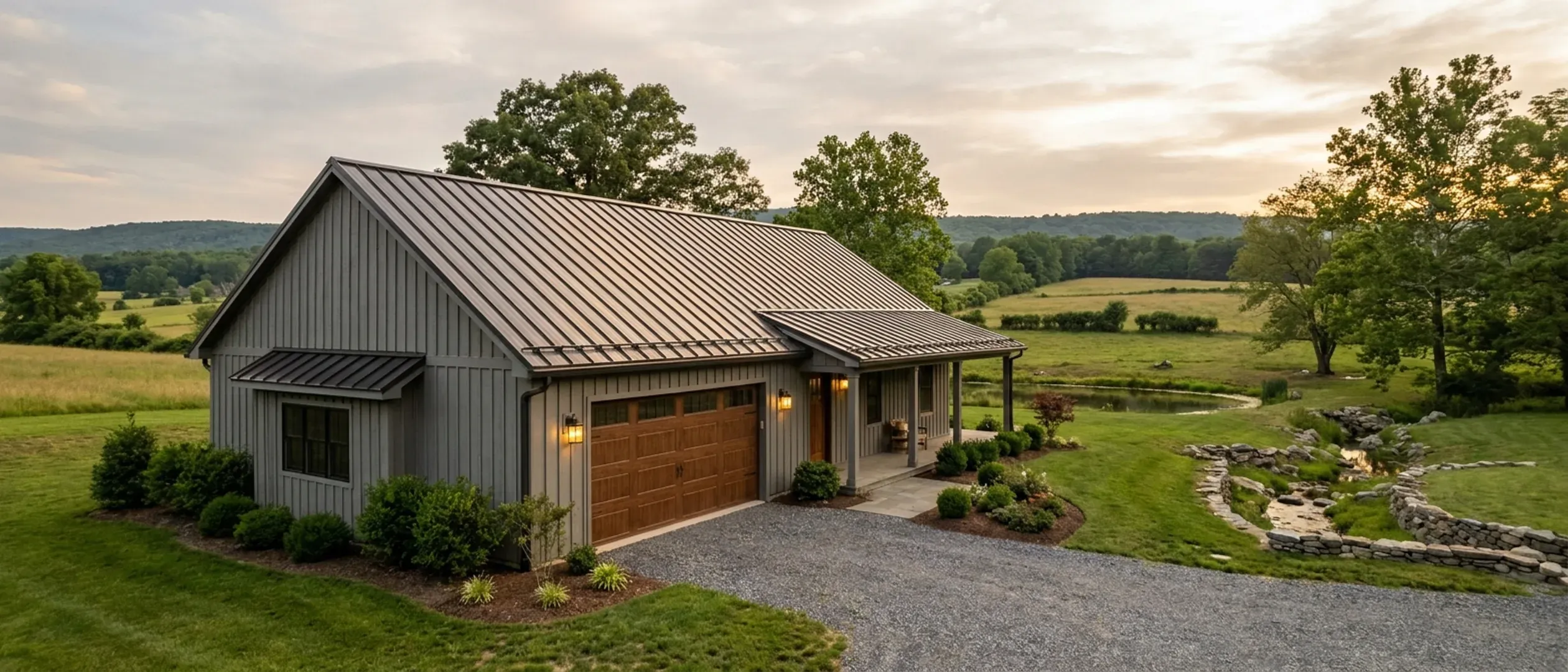
Are Barndominiums Worth It in New Jersey?
Whether a barndominium is worth it in New Jersey has less to do with the building than with the land under it and what you need the building to do. The structure's real advantages, a clear-span shell and a shop under the same roof as the house, are worth most to people who would otherwise build both. New Jersey adds its own questions: finding a lot where the municipal zoning allows the building, the approvals that come with the Pinelands, the Highlands, the coastal zone or a flood hazard area, how an insurer treats wind and flood on the design, and how an appraiser values a property with few comparable sales. This page sets out when the answer is usually yes, when it is usually no, and what to check first. It does not quote prices of its own; the cost guide covers what third parties publish.
Figures on this page are cited third-party or government data, not a quote from New Jersey Barndominium Builders.
Bottom Line Up Front
- A barndominium is usually worth it when you need a shop, equipment bay or oversized garage anyway, plan to stay for a long time, and have land whose zoning allows the building.
- It is usually not worth it on a small suburban lot, when you may sell within a few years, or when the loan depends on an appraisal that the local comparable sales cannot support.
- Before deciding, get the zoning answer for the actual lot, an insurance quote on the actual design, a lender that has financed one, and a septic and soil evaluation where there is no sewer.
When a barndominium is usually worth it
The structure's advantages are real, but they pay off for particular people and particular land.
You need the shop anyway
If you would otherwise build a house and a separate shop, garage or equipment building, one clear-span structure on one foundation can replace both, and on a New Jersey lot it uses one footprint and one set of setbacks.
You want an open plan that can change
With no interior bearing walls, the layout can be rearranged later as a remodel rather than a structural project.
You are staying a long time
The value of a building designed around how you live is highest to you. The longer you stay, the less the resale question matters.
The land is already right
Zoning that allows the building, a site outside the approvals you want to avoid or a clear route through them, and, off the sewer, soil that can take a septic system.
When it usually is not
None of these rule a barndominium out. They are the situations where a conventional house is often the simpler answer.
A small lot in a built-up municipality
Where zoning limits the size and height of accessory buildings or the lot leaves little room around the house, the clear-span and shop advantages mostly disappear.
You may sell within a few years
Fewer comparable sales and a smaller pool of buyers who want a shop can make a quick resale harder.
The loan depends on a high appraisal
If the numbers only work at an appraised value the local sales cannot support, the gap comes out of your pocket.
The shop is bigger than the house needs
What a large shop cost to build and what a buyer or appraiser will pay for it are different numbers.
What to check before deciding
Each of these can be answered before you spend anything on the building.
The zoning answer for the actual lot
Ask the municipality whether the house and shop you have in mind are permitted as of right, and what the limits on accessory buildings are.
The land overlays
Whether the lot is in the Pinelands, the Highlands, the coastal zone, a flood hazard area or near wetlands. The legal guide explains what each means.
Septic and soil
Where there is no sewer, the septic system needs a permit from the local board of health under N.J.A.C. 7:9A, based on soil testing the health agency witnesses. Do this before buying if you can.
An insurance quote on the actual design
Including the wind, hurricane and flood terms, and whether flood insurance is needed at all.
A lender that has financed one
And how its appraiser will find comparable sales. The financing guide covers the loan types.
Reading this because you are weighing a build? The next step is a plan drawn for your program.
What's different about New Jersey
The land decides more than the building
The Census Bureau's 2020 density table puts New Jersey at 1,263 people per square mile, the highest of the 50 states. Lots large enough for a wide building, a shop and, off the sewer, a septic field are the scarce part of the project. Zoning is set by each municipality, so whether a house with a large shop is allowed, and how big an accessory building can be, is a question for the specific lot.
Approvals can outweigh the build
The Uniform Construction Code applies in every municipality, and a barndominium is permitted and inspected like any other house. What varies is everything the construction office needs before it can issue the permit: zoning and, depending on the site, soil erosion and sediment control, coastal review, Pinelands review, flood hazard or wetlands decisions, and a septic permit from the local board of health. A lot that needs several of these can be worth less to a barndominium buyer than its price suggests.
Insurance: wind, hurricane and flood
The Department of Banking and Insurance says most standard homeowners policies cover windstorm and hail, but some include a separate wind or hail deductible or a mandatory or optional hurricane deductible, and that standard homeowners policies exclude flood, which needs a separate policy, normally with a 30-day waiting period. Get a quote on the actual design, with its metal roof and siding, and ask what the wind, hurricane and flood terms come to before you commit.
Farmland assessment helps the land, not the house
The Division of Taxation's farmland assessment requires at least 5 contiguous acres in agricultural or horticultural use for two years before the tax year and gross sales of at least $1,000 a year for the first 5 acres plus $5 for each additional acre. The Department of Agriculture's guide says the Act does not apply to buildings of any kind, nor to the land associated with the farmhouse. Farmland assessment never covers the house or home site; the barndominium itself is assessed like any house, and the Division of Taxation notes that a change out of farm use brings roll-back taxes.
Appraisal where comparables are thin
Fannie Mae's Selling Guide notes that in a rural area with minimal sales activity an appraiser may not be able to find three truly comparable sales from the last 12 months, that rural properties often have large lots, and that comparables a considerable distance away can be used if they produce credible results. If the loan depends on the appraisal, find a lender that has financed a barndominium before and ask how it will be valued.
Climate sets the running costs
The Office of the New Jersey State Climatologist reports 40 to 50 inches of snow a year in the Northern climate zone and, south of the Central zone, nearly twice as many days above 90 degrees as the central part of the state. Heating and cooling a steel building efficiently depends on continuous insulation and air sealing designed in from the start. That is where a barndominium's comfort and energy bills are won or lost.
Pros and cons, honestly
Pros
- A shop and a house under one roof and on one foundation.
- A clear-span floor plan that can change later.
- A kit shell can go up faster than a framed house of the same size.
- The same statewide construction code as any other house, in every municipality.
- Farm fields under the house may qualify for farmland assessment if they meet the tests.
Cons
- Suitable land is scarce and zoning varies municipality by municipality.
- Sites in the Pinelands, Highlands, coastal zone or a flood hazard area bring extra approvals.
- Wind, hurricane and flood insurance terms need checking on the actual design.
- Fewer comparable sales can make appraisal and resale harder.
- A large shop may not add value in proportion to what it cost.
Are barndominiums worth it in New Jersey?
Do barndominiums hold their value?
Is it cheaper to build a barndominium than a house in New Jersey?
Is it hard to find land for a barndominium in New Jersey?
Does homeowners insurance cover a barndominium in a hurricane or flood?
Can a barndominium on a small farm get farmland assessment?
Can I get a mortgage on a barndominium?
What should I do before deciding?
Questions answered? Tell us what you want to build and we will put real numbers against it.
Sources
- U.S. Census Bureau — Population Density of the 50 States, the District of Columbia, and Puerto Rico: 1910 to 2020
- New Jersey Department of Community Affairs — N.J.A.C. 5:23-1, Uniform Construction Code definitions (prior approvals)
- New Jersey Department of Banking and Insurance — Preparing for Extreme Weather
- New Jersey Division of Taxation — Farmland Assessment
- New Jersey Department of Agriculture — New Jersey's Farmland Assessment Act, an informational guide
- Fannie Mae Selling Guide — B4-1.3-08, Comparable Sales
- Office of the New Jersey State Climatologist, Rutgers — New Jersey Climate Overview
- N.J.A.C. 7:9A — Standards for Individual Subsurface Sewage Disposal Systems (courtesy copy, Salem County Department of Health)
Keep reading
The pages that answer the next question this one raises.
Barndominium pros and cons in New Jersey
What the building does better and worse, and the local conditions that change the balance.
Read itAre barndominiums legal in New Jersey?
Zoning, the construction code, septic approval and the land overlays.
Read itBarndominium cost
What third-party sources publish about building costs.
Read itBarndominium financing
Construction loans, appraisal and the lenders that finance barndominiums.
Read itShouses
A shop and a house under one roof.
Read itStart the survey
Tell us about your land and what you want to build.
Read itWant a real number instead of a range?
Start the survey and tell us about your land and what you want to build. Include the municipality and the block and lot if you have them, because in New Jersey the town, the land-use rules that cover the parcel and the well and septic answers change the budget more than the building does. The survey costs nothing.