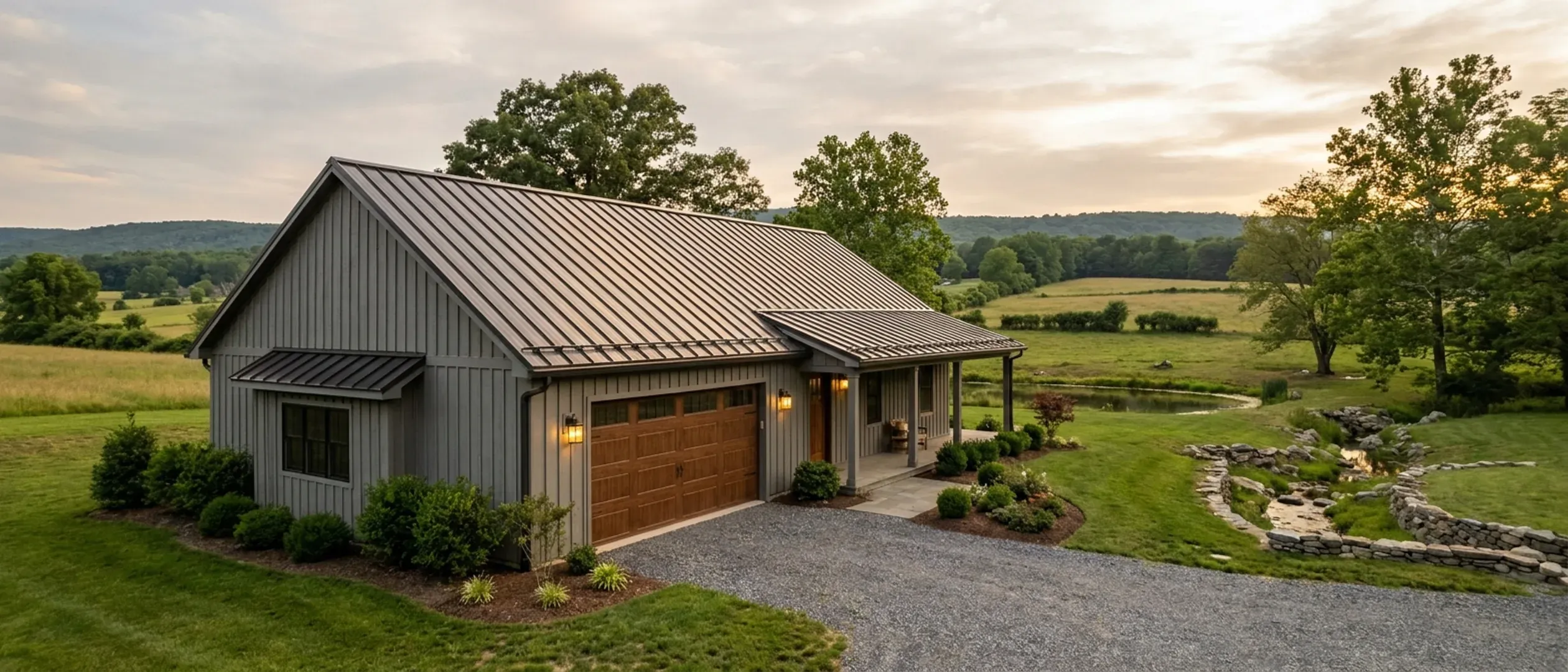
Are Barndominiums Legal in New Jersey? Zoning and Permits
Yes. New Jersey has no rule against barndominiums. A barndominium is a house with a steel or pole barn frame, and New Jersey treats it like any other house: it is built to the Uniform Construction Code, which applies in every municipality, it has to be allowed by the municipality's zoning, and on a lot without sewer its septic system needs a permit from the local board of health. What decides whether you can build one on a particular lot is the land: the zoning, and whether the lot is in the Pinelands, the Highlands, the coastal zone, a flood hazard area or near wetlands, each of which has State rules of its own. This page sets out who approves what, as of September 2026, and what to check before you buy land or apply. It describes the law; it is not legal advice, and the construction office and the agencies named here have the final word on any lot.
Figures on this page are cited third-party or government data, not a quote from New Jersey Barndominium Builders.
Bottom Line Up Front
- Barndominiums are legal in New Jersey as houses. The Uniform Construction Code, the 2024 International Residential Code in its New Jersey edition since August 17, 2026, applies to them in every municipality, and there is no agricultural exemption for a building people live in.
- Your municipality decides the zoning and, through its construction office or the Department of Community Affairs where the town has handed enforcement to it, issues the construction permit. Counties do not issue building permits in New Jersey.
- On many rural lots the harder approvals are the land ones: a septic permit from the local board of health, and review under the Pinelands, Highlands, coastal, wetlands or flood hazard rules where the lot falls inside them.
Does New Jersey allow barndominiums?
Yes, as long as the building is designed, approved and built as a house on land where a house is allowed.
A barndominium is a house
There is no separate category for barndominiums in the Uniform Construction Code. A steel or pole barn frame with a home inside is a one- or two-family dwelling, permitted and inspected like any other.
The lot decides
Whether you can build one on a particular lot depends on the municipality's zoning and on whichever State land rules apply there. Those are the questions to answer before buying land.
What the rules do not allow
Building without a construction permit, or living in the house before the certificate of occupancy: under N.J.A.C. 5:23-2.23, a new building cannot be used or occupied until the construction official has issued one. A farm building classification never covers a home.
Who approves what
Several offices may be involved. Which ones depends on where the land is.
The municipal construction office
Reviews the plans, issues the construction permit, performs the inspections and issues the certificate of occupancy, under the Uniform Construction Code. Where a municipality has asked the Department of Community Affairs to enforce the code, the Department does this instead.
The municipality's zoning officer or board
Confirms the house and any shop are allowed on the lot, or hears a request for a variance if they are not.
The local board of health
Witnesses the soil testing, issues the septic permit and the certificate of compliance for the system.
The Department of Environmental Protection
Well permits, and permits under the coastal, freshwater wetlands, flood hazard area and Highlands rules where they apply.
The Pinelands Commission
Reviews new homes in the Pinelands Area, and the health agency cannot approve a septic system there until the Commission has acted.
The soil conservation district
Certifies soil erosion and sediment control plans for construction that disturbs more than 5,000 square feet where the Act applies. Whether a single house needs certification depends on the site and the history of the lot, so ask the district.
State land rules that may apply to your lot
These overlays are where most New Jersey sites differ. None of them bans a barndominium; each adds a review.
The Pinelands
The Pinelands Commission lists 53 municipalities wholly or partly in the State-designated Pinelands Area, in Atlantic, Burlington, Camden, Cape May, Cumberland, Gloucester and Ocean Counties. Building a new house there is development under the Pinelands Comprehensive Management Plan, so it needs Pinelands review before the local approvals, and in the Forest Areas the rules limit new homes to specific cases.
The Highlands
The Highlands Council describes the region as 88 municipalities in parts of seven counties in northern New Jersey. In the Preservation Area, the State's Highlands rules exempt a single-family home only in defined cases, such as a home on a lot that existed on August 10, 2004 whose construction disturbs less than one acre and adds less than a quarter acre of impervious surface. A large barndominium with a long driveway can cross those lines.
The coastal zone (CAFRA)
Under N.J.A.C. 7:7-2.2, a single house in the coastal area needs a CAFRA permit if it is on a beach or dune, or within 150 feet of the mean high water line with no development in between. Other coastal, wetlands and flood permits can still apply further inland.
Freshwater wetlands
N.J.A.C. 7:7A requires a permit or authorization for regulated activities in freshwater wetlands and their transition areas. The septic application has to map any wetlands and transition areas near the system, so they show up early.
Flood hazard areas
Since the inland flood protection amendments took effect on July 17, 2023, the State's flood rules set the design flood elevation for inland streams above the FEMA 100-year level, three feet above it where FEMA mapping is used, and a new home's lowest floor must sit at least one foot above that design elevation. The local floodplain administrator and the Department of Environmental Protection decide how this applies to a particular lot.
Radon
In the municipalities listed as tier one in Appendix 10-A of the radon hazard subcode, N.J.A.C. 5:23-10, new homes must be built with radon-resistant features: a vapor barrier and gravel base under the slab and a vent pipe system to the outside.
What to check before you buy land or apply
Each of these can be answered before you commit to a lot or a design.
Zoning for the actual lot
Ask the municipality whether a house and the shop you want are permitted as of right, and the limits on accessory buildings, height and setbacks.
Which overlays apply
Whether the lot is in the Pinelands Area, the Highlands Preservation Area, the coastal zone, a flood hazard area, or near wetlands.
Sewer or septic
If there is no public sewer, a septic evaluation witnessed by the local health agency shows whether and where a system can go, and that shapes where the house can go.
Who enforces the code
The municipality's own construction office, a shared service, or the Department of Community Affairs. The permitting page explains how the application comes together.
Owner-builder paperwork
If you are building the house yourself, the permit application includes an owner's affidavit about the New Home Warranty program.
Reading this because you are weighing a build? The next step is a plan drawn for your program.
What's different about New Jersey
One construction code, in every municipality
The Uniform Construction Code provides, in the words of N.J.A.C. 5:23-3.1, a uniform system of construction standards throughout the State. For houses, the one- and two-family dwelling subcode is the 2024 International Residential Code, New Jersey edition, in effect since August 17, 2026, with a six-month grace period in which a complete application may still be reviewed under the previous code. Every municipality appoints a construction official, runs enforcement through a shared service with another municipality, or asks the Department of Community Affairs to act as its enforcing agency. Either way, the permit comes from the enforcing agency for the municipality where the land is.
No farm exemption for a home
The Uniform Construction Code has a category for commercial farm buildings, but N.J.A.C. 5:23-3.2 excludes residential structures from it, and even commercial farm buildings are built to code. A barndominium someone lives in is a dwelling, reviewed and inspected as one, whether or not it stands on a farm.
Zoning is local
The State Uniform Construction Code Act says nothing in it affects local zoning ordinances. Zoning is set by each municipality, and it decides whether a house is allowed on the lot, how big and how tall buildings can be, where they can sit, and how large an accessory shop may be. Zoning approval is one of the prior approvals the construction office needs before it can issue a permit.
Sealed plans
Under N.J.A.C. 5:23-2.15, each sheet of the plans submitted for a new house carries the seal and signature of the registered architect or licensed engineer who prepared them. The construction official waives that for a homeowner who prepares the plans for their own detached private residence and files an affidavit, except for the structural design of a new home in a coastal V zone. Under the Board of Architects' rule, catalogue plans can be used only after a New Jersey licensed architect has reviewed, signed, sealed and adapted them to the site.
Septic systems and wells
Septic systems follow the Department of Environmental Protection's standards in N.J.A.C. 7:9A and are permitted by the board of health with jurisdiction, which may be a county, regional or municipal health agency depending on the town. The design is signed and sealed by a New Jersey licensed professional engineer, based on soil logs and permeability tests the health agency witnesses, and is sized at 200 gallons a day for the first bedroom and 150 for each additional one, so 500 gallons a day for three bedrooms. A new well needs a State well permit and a New Jersey licensed well driller under N.J.A.C. 7:9D.
Design figures the State sets, and the ones it does not
New Jersey's edition of the residential code fixes the footing frost depth at 36 inches in Mercer and Middlesex Counties and every county to the north, and 30 inches in Monmouth and Burlington Counties and every county to the south. It rates the termite hazard moderate to heavy and exempts one- and two-family dwellings from seismic requirements. It does not set one snow load or wind speed for the state: the Department of Community Affairs points designers to site-specific hazard tools. An unsprinklered house of unprotected wood-framed construction is limited to two stories, 35 feet in height and 4,800 square feet per floor.
Pros and cons, honestly
Pros
- One construction code applies in every municipality, so a barndominium is reviewed like any house.
- No special category or ban applies to barndominiums.
- The law requires new homes built by a builder to be enrolled in a State-approved warranty plan.
- The State sets the frost depth, so footing depth is the same across each half of the state.
Cons
- Zoning varies municipality by municipality and may limit large accessory shops.
- Pinelands, Highlands, coastal, wetlands and flood rules add reviews on many rural lots.
- A septic system needs its own permit from the local board of health.
- Permit plans must be sealed by a New Jersey architect or engineer unless you draw your own plans for your own home.
- There is no farm exemption for a building people live in.
Does New Jersey allow barndominiums?
Do I need a building permit for a barndominium in New Jersey?
Which building code applies?
Can I build a barndominium on farmland without a permit?
Do I need an architect or engineer for a barndominium in New Jersey?
Can I build my own barndominium in New Jersey?
Can I build a barndominium in the Pinelands?
Can I build a barndominium in a flood zone in New Jersey?
Questions answered? Tell us what you want to build and we will put real numbers against it.
Sources
- New Jersey Department of Community Affairs — Current Construction Codes
- New Jersey Department of Community Affairs — N.J.A.C. 5:23-3, Uniform Construction Code subcodes (incl. 5:23-3.2 and the one- and two-family dwelling subcode, 5:23-3.21)
- New Jersey Department of Community Affairs — N.J.A.C. 5:23-2, administration and enforcement (permits, sealed plans, owner affidavit, certificates)
- New Jersey Department of Community Affairs — N.J.A.C. 5:23-1, general provisions (prior approvals, grace period)
- New Jersey Department of Community Affairs — State Uniform Construction Code Act, N.J.S.A. 52:27D-119 et seq.
- New Jersey Department of Community Affairs — Bulletin 19-1, design loads (snow and wind)
- New Jersey Department of Community Affairs — New Home Warranty and Builders' Registration Act, N.J.S.A. 46:3B
- New Jersey Department of Community Affairs — Builder Registration and New Home Warranty for Builders
- N.J.A.C. 5:25-2.1 — Builder registration required (LII)
- N.J.A.C. 13:27-3.4 — Single family dwelling exemption, Board of Architects (LII)
- N.J.A.C. 7:9A — Standards for Individual Subsurface Sewage Disposal Systems (courtesy copy, Salem County Department of Health)
- N.J.A.C. 7:9A-7.4 — Volume of sanitary sewage (LII)
- N.J.A.C. 7:9D-1.6 — Well permits and well driller licensing (LII)
- New Jersey Pinelands Commission — Pinelands Municipalities
- N.J.A.C. 7:50-4.1 — Pinelands Comprehensive Management Plan, applicability (LII)
- New Jersey Highlands Water Protection and Planning Council
- N.J.A.C. 7:38-2.3 — Highlands exemptions (LII)
- N.J.A.C. 7:7-2.2 — CAFRA (LII)
- N.J.A.C. 7:7A-2.1 — Freshwater wetlands, when a permit is required (LII)
- N.J.A.C. 7:13-3.4 — Flood hazard area based on FEMA flood mapping (LII)
- N.J.A.C. 7:13-12.5 — Flood hazard area requirements for a building (LII)
- New Jersey Department of Community Affairs — N.J.A.C. 5:23-10, Radon Hazard Subcode
- New Jersey Department of Agriculture — Soil Erosion and Sediment Control Program
Keep reading
The pages that answer the next question this one raises.
Permitting
How the permit application and prior approvals come together.
Read itHow long a barndominium build takes
The review and inspection deadlines, the septic permit and the stages in order.
Read itBarndominium pros and cons in New Jersey
Land, snow, coastal storms, radon and appraisal.
Read itSite preparation
Clearing, grading and the building pad once approvals are in place.
Read itCustom plans
Concept floor plans to take to a New Jersey architect or engineer.
Read itStart the survey
Tell us where your land is and what you want to build.
Read itWant a real number instead of a range?
Start the survey and tell us about your land and what you want to build. Include the municipality and the block and lot if you have them, because in New Jersey the town, the land-use rules that cover the parcel and the well and septic answers change the budget more than the building does. The survey costs nothing.