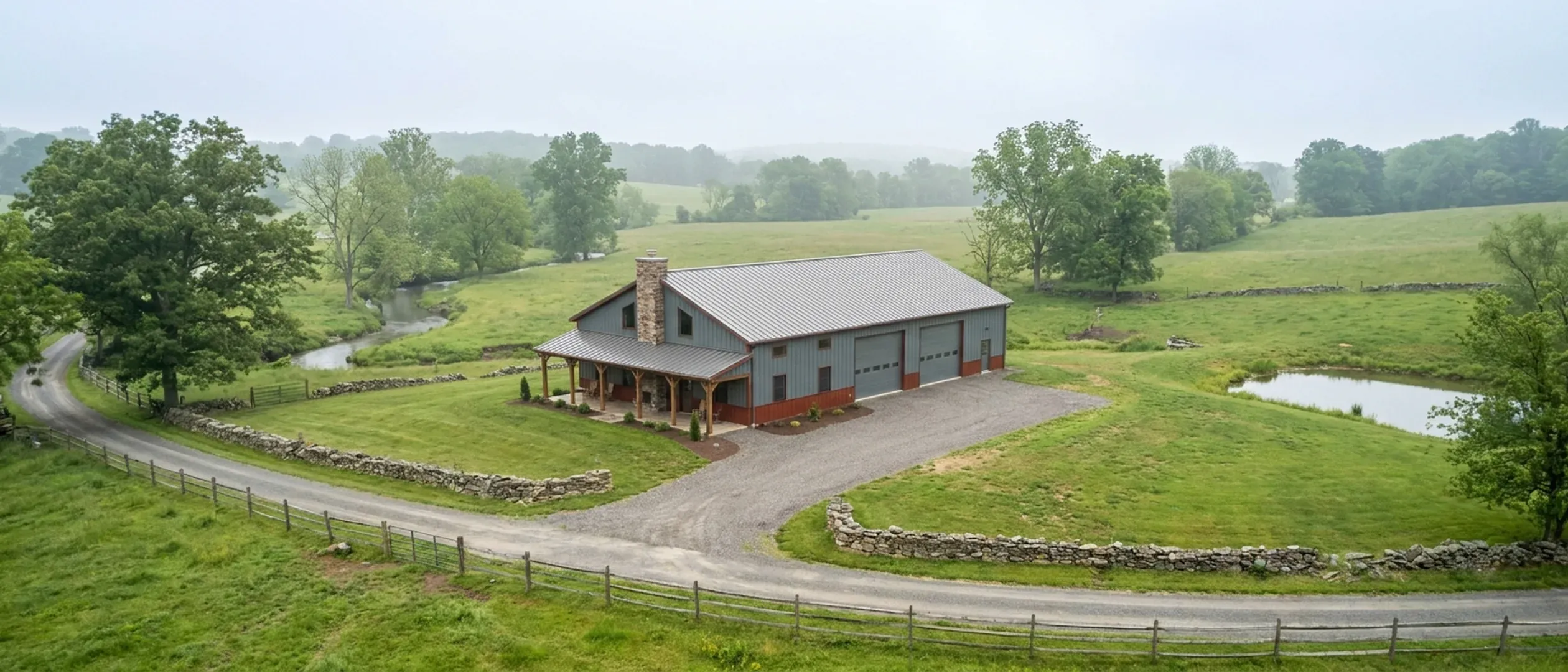
How Much Does a Barndominium Cost in New Jersey?
Nobody publishes a measured cost for building a barndominium in New Jersey, and a page that hands you one statewide price per square foot is guessing. What does exist is better than a guess. The Census Bureau measures what owners pay a general contractor to build a house on land they already own, and it reports the Northeast region, which includes New Jersey, on its own. The Census Bureau also counts every new home permitted in New Jersey and the construction value on those permits. USDA publishes what a New Jersey acre is worth, and the Department of Community Affairs publishes what the average New Jersey homeowner pays in property tax. This guide sets those figures side by side, each with its source, and shows which part of the budget a steel or pole barn shell actually changes. None of it is our pricing, and none of it is a quote.
Figures below are industry data from cited third-party sources, not a quote from New Jersey Barndominium Builders. Every project is priced individually.
Bottom Line Up Front
- The closest published benchmark is the Census Bureau's 2025 figure for contractor-built houses on the owner's own land in the Northeast region: a median contract price of $179.30 per square foot and an average of $246.26, with the land excluded.
- Land in New Jersey is expensive by any national measure: USDA's 2026 Land Values survey puts New Jersey cropland at $17,100 an acre and pasture at $15,600, against a national cropland average of $6,020.
- The costs keep running after the build. The Department of Community Affairs puts the 2025 average New Jersey residential property tax bill at $10,570, and county averages run from $5,114 in Cumberland County to $14,460 in Essex County.
Published cost figures
Third-party and government figures, each with its source. None of them is a quote, and none of them is ours.
| Measure | Range | Source |
|---|---|---|
| Contractor-built houses on the owner's land, Northeast region, started in 2025: median to average contract price (land excluded) | $179–$246 per sq ft | U.S. Census Bureau, Characteristics of New Housing 2025, Median and Average Contract Price per Square Foot of New Contractor-Built Single-Family Houses Started: Northeast median $179.30, average $246.26 (read 26 Sep 2026) — https://www.census.gov/construction/chars/xls/contractpricesqft_cust.xls |
| Detached new houses sold by builders, Northeast region, 2025: median to average sales price (lot excluded) | $233–$278 per sq ft | U.S. Census Bureau, Characteristics of New Housing 2025, Median and Average Price per Square Foot of Floor Area in Detached New Single-Family Houses Sold: Northeast median $232.57, average $277.66 (read 26 Sep 2026) — https://www.census.gov/construction/chars/xls/soldpricesqft_cust.xls |
| Average construction cost alone (no lot, overhead, marketing or profit), national builder survey, 2024 | $162 per sq ft | NAHB, Cost of Constructing a Home 2024 (Eric Lynch, 20 Jan 2025): average construction cost $428,215, about $162 per square foot; national, no regional breakdown (read 26 Sep 2026) — https://www.nahb.org/-/media/NAHB/news-and-economics/docs/housing-economics-plus/special-studies/2025/special-study-cost-of-constructing-a-home-2024-january-2025.pdf |
| Average construction value on a New Jersey single-family building permit, 2025 (12,820 homes) | $270,800 per home | U.S. Census Bureau, Building Permits Survey, annual 2025 by state: New Jersey 1-unit 12,820 homes, valuation $3,471,089 thousand; arithmetic $270,757 per home, rounded (read 26 Sep 2026) — https://www.census.gov/construction/bps/xls/stateannual_202599.xls |
| New Jersey agricultural land, 2026 state average: pasture to cropland | $15,600–$17,100 per acre | USDA NASS, Land Values 2026 Summary (July 2026): New Jersey pasture $15,600, cropland $17,100 per acre; farm real estate $17,000 (read 26 Sep 2026) — https://www.nass.usda.gov/Publications/Todays_Reports/reports/land0726.pdf |
| Average residential property tax bill, 2025, by New Jersey county: lowest (Cumberland) to highest (Essex) | $5,114–$14,460 per year | New Jersey Department of Community Affairs, 2025 Property Tax Information, County Tax Summary: average total property taxes on a residential property, before credits and deductions; statewide $10,570 (read 26 Sep 2026) — https://www.nj.gov/dca/dlgs/resources/Property_Tax/25_data/25taxes.xls |
Total cost by size
Rough totals at common sizes. These move with everything on this page, so treat them as a starting orientation, not an estimate for your project.
1,500 sq ft
$269,000–$369,000
Arithmetic, rounded to the nearest $1,000: 1,500 sq ft × the Census 2025 Northeast contract price per sq ft for contractor-built houses ($179.30 median, $246.26 average), land excluded — https://www.census.gov/construction/chars/xls/contractpricesqft_cust.xls
2,000 sq ft
$359,000–$493,000
Arithmetic, rounded to the nearest $1,000: 2,000 sq ft × the Census 2025 Northeast contract price per sq ft for contractor-built houses ($179.30 median, $246.26 average), land excluded — https://www.census.gov/construction/chars/xls/contractpricesqft_cust.xls
2,400 sq ft
$430,000–$591,000
Arithmetic, rounded to the nearest $1,000: 2,400 sq ft (a 40x60 footprint) × the Census 2025 Northeast contract price per sq ft for contractor-built houses ($179.30 median, $246.26 average), land excluded — https://www.census.gov/construction/chars/xls/contractpricesqft_cust.xls
3,000 sq ft
$538,000–$739,000
Arithmetic, rounded to the nearest $1,000: 3,000 sq ft × the Census 2025 Northeast contract price per sq ft for contractor-built houses ($179.30 median, $246.26 average), land excluded — https://www.census.gov/construction/chars/xls/contractpricesqft_cust.xls
What actually moves the number
The land, before anything else
USDA's 2026 survey puts New Jersey farm real estate at $17,000 an acre, cropland at $17,100 and pasture at $15,600. Those are state averages across working farmland. A buildable lot with road frontage near a New Jersey town is a different market, and it is priced parcel by parcel.
The finish schedule, not the frame
NAHB's 2024 survey puts interior finishes at 24.1% of construction cost and the plumbing, electrical and HVAC rough-ins at another 19.2%. A barndominium needs the same cabinets, flooring, drywall and mechanical systems as any other house, so the finishes you choose move the total more than the steel or pole barn shell does.
Septic, well and the ground under them
The Census Bureau reports that 58% of contractor-built homes completed in the Northeast in 2025 had their own septic system. In New Jersey the design must be signed and sealed by a New Jersey-licensed professional engineer and permitted by the local board of health, and a new well needs a DEP well permit and a licensed well driller. Those are engineering and drilling costs a sewered subdivision lot does not carry.
Property tax, every year after
The Department of Community Affairs puts the 2025 average residential property tax bill in New Jersey at $10,570 before credits and deductions. The combined equalized tax rate it publishes runs from about $0.65 per $100 of value in Cape May County to about $2.73 in Salem County, so the same house carries a very different yearly cost depending on the town.
Average cost of a barndominium in New Jersey
There is no published average for barndominiums in New Jersey. There are two published averages for new houses that come close, and they bracket the question from different sides.
The Census contractor-built figure for the Northeast
The Census contractor-built category is a house built by a general contractor on land the owner already has, which is how a barndominium is normally built. The Census Bureau excludes the lot from the contract price. For houses started in 2025 it reports a Northeast median of $179.30 per square foot and an average of $246.26, and a whole-house Northeast median contract price of $431,100 with an average of $745,900.
The New Jersey permit valuation
The Census Bureau's Building Permits Survey counted 12,820 single-family homes authorized in New Jersey in 2025, with a combined construction valuation of about $3.47 billion: roughly $270,800 per home. That is the construction value reported on the permits, and it is lower than what owners report paying a contractor, so treat it as a floor rather than a budget.
Why the average and the median are so far apart
The Northeast average contract price per square foot ($246.26) sits well above the median ($179.30) in the Census 2025 figures. A few very expensive custom houses pull the average up. For a planning number, the median is the better anchor; the average shows how high finish choices can take a custom home.
It is a house benchmark, not a barndominium price
The Census series does not separate barndominiums from other houses, and 97% of the contractor-built homes it counted in the Northeast in 2025 were wood-framed, with steel under half a percent. Use it as the frame of reference for a finished house, then adjust for how much of your building is living space and how you finish it.
Cost per square foot, and what it leaves out
A cost per square foot is only useful if you know which square feet it counts and which costs it excludes.
Heated living space, not the whole building
Census measures finished floor area. A barndominium with a 1,200-square-foot shop under the same roof has two very different kinds of space: a finished house and a garage-grade shell. Price each at its own rate rather than running the whole footprint through a house figure.
Land is excluded
Both Census price-per-square-foot series exclude the value of the lot. In New Jersey, where USDA puts even farmland at $15,600 to $17,100 an acre in 2026, land is a separate and large line.
Site work is mostly excluded from a kit price
NAHB's survey puts site work at 7.6% of construction cost and foundations at 10.5% on a typical lot. On a rural New Jersey parcel, site work also takes in the septic system, the well, the driveway and the trenching to the utilities, none of which a building package includes.
Permit and hookup fees are local
NAHB's survey averages building permit fees at $7,640, or 1.8% of construction cost, with impact fees and water and sewer fees on top. In New Jersey the municipal construction office charges the permit fees, and the utility or the local board of health sets the rest.
Barndominium kit prices vs turnkey cost
Kit prices are the number most people see first. They describe a different thing from the cost of a finished home.
A kit is the shell's materials
A barndominium kit or shell package is typically the steel or post-frame structure, the roof and wall panels, and the doors and windows the seller lists. It is not the foundation, the erection labour, the insulation, the interior, the mechanical systems, the septic or the well. Read the inclusion list line by line.
The frame and roof are a minority of the cost
NAHB puts framing at 16.6% of construction cost, with framing including the roof at 11.6% and roofing as an exterior finish at 3.9%. That is the part of the budget a kit replaces. Interior finishes (24.1%) and the plumbing, electrical and HVAC rough-ins (19.2%) are still to come.
Turnkey means one contract for all of it
A turnkey build prices the kit, the site work, the foundation, the shell, the interior and the trade work together, so it is the number to compare with the Census contract price. In New Jersey, licensed trade contractors handle the plumbing, electrical and HVAC, and permit plans are sealed by a New Jersey-licensed architect or professional engineer.
Compare like with like
When two numbers differ by half, check whether one is a kit and the other a finished house. Our barndominium kits and turnkey builds pages explain what each covers.
Where the money in a house actually goes
NAHB's 2024 Construction Cost Survey breaks a typical new home into stages. The survey is national, and NAHB says its sample is not large enough for a geographic breakdown, but the shares show what a steel or pole barn shell can and cannot change.
The inside is the largest share
Interior finishes are 24.1% of construction cost in NAHB's survey, the largest of its stages, with cabinets and countertops at 4.5% and flooring at 3.6%. Major systems rough-ins add 19.2%: plumbing 6.3%, electrical 6.4% and HVAC 6.3%.
The shell is where barndominiums differ
Framing and exterior finishes together are 30% of construction cost in NAHB's survey (16.6% and 13.4%). A clear-span steel or pole barn building changes that share, and it changes how the interior is laid out, but it leaves the other 70% in place.
The lot was 13.7% of a builder's sales price
NAHB reports that for the homes in its survey, 64.4% of the sales price went to construction and 13.7% to the finished lot. In New Jersey, with land at the prices USDA reports, the land share of a custom build on acreage can be far larger than that national figure.
Size matters more than style
Contractor-built houses completed in the Northeast in 2025 had a median of 2,495 square feet and an average of 2,867, according to the Census Bureau. Every square foot you do not build is a square foot you do not finish, heat or pay tax on.
Reading this because you are weighing a build? The next step is a plan drawn for your program.
What's different about New Jersey
Footings go below a frost depth the State sets
New Jersey's residential code (N.J.A.C. 5:23-3.21) sets frost depth in two zones: 36 inches in Mercer and Middlesex Counties and every county to the north, and 30 inches in Monmouth and Burlington Counties and every county to the south. A slab-on-grade barndominium still needs its perimeter footings carried to that depth, which is part of the foundation line in the budget.
Farmland assessment covers the land, not the house
The Division of Taxation's criteria for farmland assessment start at 5 contiguous acres in agricultural or horticultural use for two years, with gross sales of at least $1,000 a year for the first 5 acres plus $5 per additional acre. The Department of Agriculture's guide to the program says it does not apply to buildings of any kind, nor to the land associated with the farmhouse: a barndominium you live in is assessed like any other house.
Changing farmland to a house site can trigger roll-back taxes
The Division of Taxation says that when land changes from agricultural use to a non-farm use, roll-back taxes are assessed for the year of the change and the two previous years, as the difference between the farmland assessment and the ordinary assessment. If the parcel you are buying is farmland assessed, ask the municipal tax assessor what a house site will do to it before you close.
Flood insurance at the Shore and along the rivers
Rutgers' New Jersey Climate Change Resource Center reports that federally regulated lenders must require flood insurance on loans secured by property in a FEMA Special Flood Hazard Area. Its 2018 figures put the average New Jersey NFIP premium at $4,738 a year in the V zone, where waves and storm surge apply, and $1,272 in the A zone. Those are 2018 numbers: get a current quote for the parcel and the building's elevation before you settle the budget.
A big single-floor footprint has a code ceiling
New Jersey's edition of the 2024 International Residential Code caps an unsprinklered wood-framed house at 4,800 square feet per floor. A larger footprint needs sprinklers or a different construction type, and that decision belongs to your design professional and the municipal construction office, not to a price list.
What is the average cost of a barndominium in New Jersey?
How much does it cost to build a barndominium per square foot in New Jersey?
Is a barndominium cheaper to build than a regular house in New Jersey?
What does land cost for a barndominium in New Jersey?
How much are property taxes on a new barndominium in New Jersey?
Does farmland assessment lower the taxes on a barndominium?
What do a septic system and well add in New Jersey?
Can you give me a price for my project?
Questions answered? Tell us what you want to build and we will put real numbers against it.
Sources
- U.S. Census Bureau — Median and Average Contract Price per Square Foot of New Contractor-Built Single-Family Houses Started (Characteristics of New Housing, 2025) — Northeast 2025: median $179.30, average $246.26 per sq ft, lot excluded. Read 26 Sep 2026.
- U.S. Census Bureau — Median and Average Contract Price of New Contractor-Built Single-Family Houses Started — Northeast 2025: median $431,100, average $745,900. Read 26 Sep 2026.
- U.S. Census Bureau — Median and Average Price per Square Foot of Floor Area in New Single-Family Houses Sold — Detached, Northeast 2025: median $232.57, average $277.66. Read 26 Sep 2026.
- U.S. Census Bureau — Square Feet of Floor Area in New Single-Family Houses Completed — Contractor-built, Northeast 2025: median 2,495 sq ft, average 2,867. Read 26 Sep 2026.
- U.S. Census Bureau — Type of Sewage System by Water Supply Source in New Single-Family Houses Completed — Contractor-built, Northeast 2025: 58% individual septic system. Read 26 Sep 2026.
- U.S. Census Bureau — Type of Framing in New Single-Family Houses Completed — Contractor-built, Northeast 2025: wood 97%, concrete 3%, steel under 0.5%. Read 26 Sep 2026.
- U.S. Census Bureau — Building Permits Survey, New Privately Owned Housing Units Authorized, annual 2025 by state — New Jersey 1-unit: 12,820 units, valuation $3,471,089 thousand. Read 26 Sep 2026.
- NAHB — Cost of Constructing a Home 2024 (Eric Lynch, 20 Jan 2025) — Average construction cost $428,215 (about $162/sq ft); Table 3 stage and line shares. Read 26 Sep 2026.
- USDA National Agricultural Statistics Service — Land Values 2026 Summary (July 2026) — New Jersey 2026: farm real estate $17,000, cropland $17,100, pasture $15,600 per acre; U.S. cropland $6,020. Read 26 Sep 2026.
- New Jersey Department of Community Affairs — 2025 Property Tax Information (County Tax Summary) — Average residential property taxes before credits: statewide $10,570; Cumberland $5,114; Essex $14,460. Combined equalized rates. Data as of 14 Jan 2026; read 26 Sep 2026.
- New Jersey Division of Taxation — New Jersey Farmland Assessment — Eligibility criteria and roll-back taxes. Read 26 Sep 2026.
- New Jersey Department of Agriculture — New Jersey's Farmland Assessment Act: An Informational Guide — The Act does not apply to buildings or to the land associated with the farmhouse. Read 26 Sep 2026.
- Rutgers, New Jersey Climate Change Resource Center — The National Flood Insurance Program and New Jersey — Lender requirement in the SFHA; 2018 average premiums $4,738 (V zone), $1,272 (A zone). Read 26 Sep 2026.
- N.J.A.C. 5:23-3 (Uniform Construction Code, subcodes), Department of Community Affairs — 5:23-3.21: IRC/2024 NJ edition; frost depth 36 in (north zone) and 30 in (south zone); R300 4,800 sq ft per floor cap for unsprinklered wood-framed houses.
- N.J.A.C. 7:9A-7.4, Standards for Individual Subsurface Sewage Disposal Systems (Legal Information Institute) — Design volume: 200 gal/day first bedroom, 150 each additional.
Keep reading
The pages that answer the next question this one raises.
Barndominium vs. house cost
The same NAHB cost stages, compared for a steel or pole barn shell and a conventionally framed house.
Read itHow big a barndominium your budget builds
Working backward from a budget to square footage, after land and site costs come off the top.
Read itBarndominium financing in New Jersey
Construction-to-permanent loans, conforming loan limits by county, Farm Credit and NJHMFA.
Read itBarndominiums for sale in New Jersey
Why finished barndominiums rarely come up for sale here, and where to look if you want to buy one.
Read itSite preparation
Pad, driveway, utilities, septic and well: the ground work that happens before the building exists.
Read it40x60 barndominium floor plans
The 2,400-square-foot footprint used in the cost table above.
Read itWant a real number instead of a range?
Start the survey and tell us about your land and what you want to build. Include the municipality and the block and lot if you have them, because in New Jersey the town, the land-use rules that cover the parcel and the well and septic answers change the budget more than the building does. The survey costs nothing.