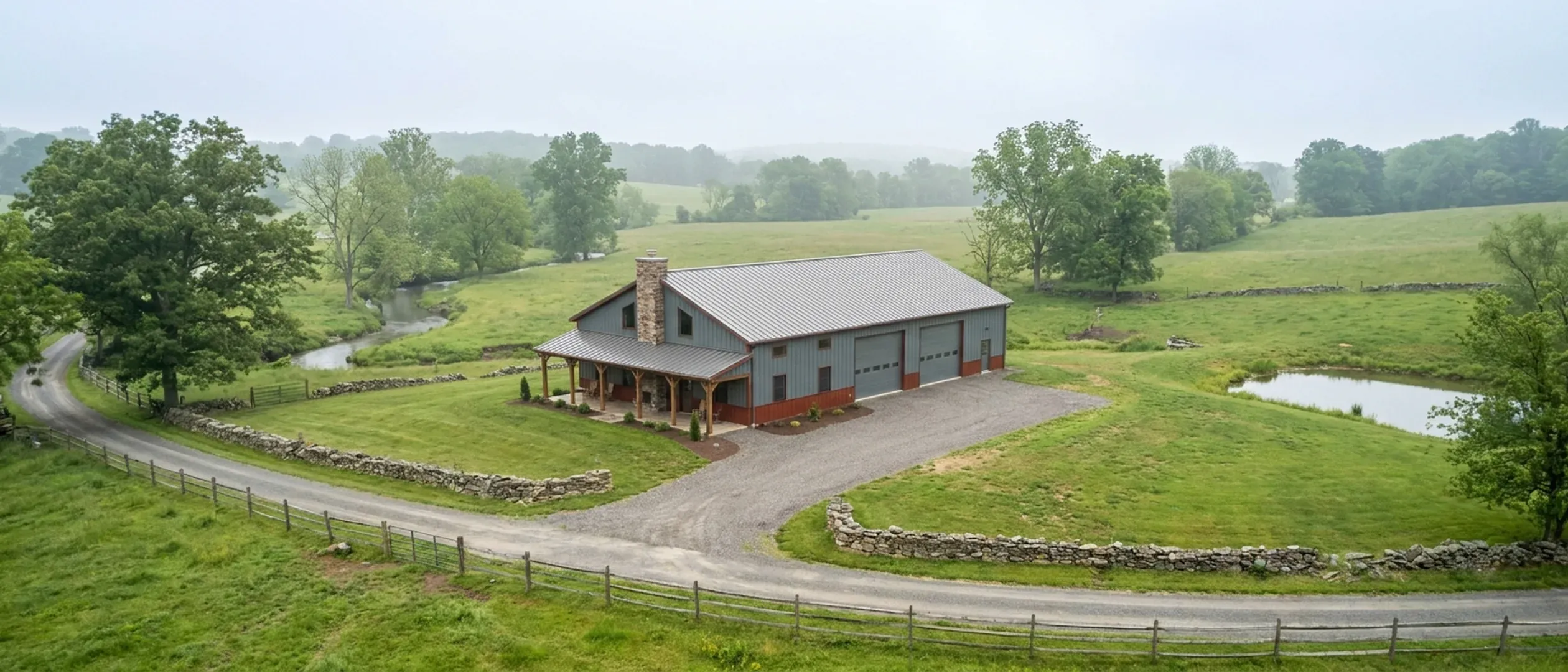
How Big a Barndominium Can You Build in New Jersey on Your Budget?
The question people actually ask is not what a barndominium costs but how much barndominium their money buys. You can answer it with published numbers, as long as you do it in the right order. In New Jersey, land, septic, well and site work come off the top before a single square foot is built, and they are large here. What is left, divided by what the Census Bureau reports owners in the Northeast pay a contractor per square foot, gives a first answer. This guide walks through that arithmetic with each figure's source. It is arithmetic on third-party data, not a quote and not our pricing.
Figures below are industry data from cited third-party sources, not a quote from New Jersey Barndominium Builders. Every project is priced individually.
Bottom Line Up Front
- At the Census Bureau's 2025 Northeast median contract price of $179.30 per square foot (land excluded), $200,000 of building budget covers about 1,100 square feet of finished house, and $500,000 about 2,800.
- At the Census Northeast average of $246.26 per square foot, the same budgets cover about 810 and 2,030 square feet. The gap between those answers is mostly finish level.
- Take land, septic, well, driveway and utilities off the top first. USDA puts 2026 New Jersey cropland at $17,100 an acre, so in New Jersey the land line alone can decide what is left for the building.
Published cost figures
Third-party and government figures, each with its source. None of them is a quote, and none of them is ours.
| Measure | Range | Source |
|---|---|---|
| Contractor-built houses on the owner's land, Northeast region, started in 2025: median to average contract price (land excluded) | $179–$246 per sq ft | U.S. Census Bureau, Characteristics of New Housing 2025, Median and Average Contract Price per Square Foot of New Contractor-Built Single-Family Houses Started: Northeast median $179.30, average $246.26 (read 26 Sep 2026) — https://www.census.gov/construction/chars/xls/contractpricesqft_cust.xls |
| New Jersey agricultural land, 2026 state average: pasture to cropland | $15,600–$17,100 per acre | USDA NASS, Land Values 2026 Summary (July 2026): New Jersey pasture $15,600, cropland $17,100 per acre (read 26 Sep 2026) — https://www.nass.usda.gov/Publications/Todays_Reports/reports/land0726.pdf |
What actually moves the number
Land first
If you do not own the land yet, it is the first subtraction. USDA's 2026 averages for New Jersey are $15,600 an acre for pasture and $17,100 for cropland, and a buildable lot near a town is priced parcel by parcel above that.
Septic and well next
On a rural parcel, a septic system designed and sealed by a New Jersey-licensed professional engineer and a DEP-permitted well come before the house. The Census Bureau reports that 58% of contractor-built homes completed in the Northeast in 2025 had their own septic system.
Then the site
NAHB's survey puts site work at 7.6% of construction cost and the driveway at 2.3% on a typical lot. A house set back on acreage needs a longer drive and longer utility runs.
Then the square footage
Divide what is left by a price per square foot. The Census Bureau's 2025 Northeast figures for contractor-built houses are $179.30 (median) and $246.26 (average), land excluded.
How big of a barndominium can I build for $100,000 or $200,000?
Here is the arithmetic on the building budget alone, after land, septic, well and site work are paid for. Each figure is the budget divided by the Census Bureau's 2025 Northeast contract price per square foot, rounded to the nearest 10 square feet.
$100,000 of building budget
About 560 square feet at the Census Northeast median ($179.30 per square foot), or about 410 at the average ($246.26). That is a small cabin-sized home; some owners at this budget build the shell first and finish the inside over time.
$200,000 of building budget
About 1,120 square feet at the Northeast median, or about 810 at the average. At this budget a one- or two-bedroom plan with a modest shop bay is the realistic range; see the small barndominium plans.
$300,000 of building budget
About 1,670 square feet at the Northeast median, or about 1,220 at the average. That is the range of a compact three-bedroom barndominium.
$500,000 of building budget
About 2,790 square feet at the Northeast median, or about 2,030 at the average. A fully finished 40x60 barndominium is 2,400 square feet.
What to subtract before you divide
The per-square-foot figures exclude land, and on a rural parcel they leave out much of the site. In New Jersey these subtractions are large.
The land, if you are buying it
USDA's 2026 survey puts New Jersey farm real estate at $17,000 an acre on average. USDA's national average for farm real estate is $4,500. At nearly four times the national figure, the land line comes first.
The septic system and well
The septic design must be signed and sealed by a New Jersey-licensed professional engineer from soil logs and permeability tests, and the local board of health issues the permit. A new well needs a DEP well permit and a New Jersey-licensed well driller. Price both before the house.
Permits, surveys and plans
NAHB's survey puts building permit fees at 1.8% of construction cost and architecture and engineering at 1.5%. In New Jersey, permit plans for a new house are sealed by a New Jersey-licensed architect or professional engineer.
A contingency
Hold back part of the budget for what the soil test, the survey or the construction office turns up. A plan that spends every dollar on square footage leaves nothing for the surprises that every site has.
How big new houses in the Northeast actually are
The Census Bureau publishes the size of contractor-built houses completed in the Northeast. It is a useful check on what a budget is trying to buy.
The middle of the market
Contractor-built houses completed in the Northeast in 2025 had a median of 2,495 square feet and an average of 2,867, according to the Census Bureau.
The spread
Of those houses, 13% were under 1,400 square feet, 16% were 1,400 to 1,799, 18% were 1,800 to 2,399, 16% were 2,400 to 2,999, 17% were 3,000 to 3,999, and 21% were 4,000 square feet or more.
Living space vs. shop space
Those are finished-floor figures. A barndominium's shop or garage bay is not finished living space and costs far less per square foot, so a building with a large shop can be bigger overall than the budget arithmetic above suggests.
Size is a lifetime cost
Every finished square foot is heated, cooled, insured and taxed for as long as you own the house. In a state where the average residential property tax bill was $10,570 in 2025, according to the Department of Community Affairs, a smaller, well-planned house is often the better budget decision.
Reading this because you are weighing a build? The next step is a plan drawn for your program.
What's different about New Jersey
Septic is sized by bedrooms, not square feet
New Jersey's septic standards (N.J.A.C. 7:9A-7.4) design a house for 200 gallons a day for the first bedroom and 150 for each additional bedroom, with a 350-gallon minimum. A three-bedroom house is designed for 500 gallons a day. Adding a bedroom changes the septic design as well as the floor plan.
One big floor has a ceiling
New Jersey's residential code caps an unsprinklered wood-framed house at 4,800 square feet per floor; a larger footprint needs sprinklers or a different construction type. Budgets large enough to reach that size should settle it with the design professional early.
Every square foot is taxed every year
The Department of Community Affairs puts the 2025 average residential property tax bill at $10,570 before credits, with county averages from $5,114 in Cumberland County to $14,460 in Essex County. A bigger house raises the assessment, so size is a yearly cost as well as a building cost.
Footings go to the State's frost depth
N.J.A.C. 5:23-3.21 sets frost depth at 36 inches in Mercer and Middlesex Counties and every county to the north, and 30 inches in Monmouth and Burlington Counties and every county to the south. A larger footprint means more perimeter footing at that depth.
How big of a barndominium can I build for $100,000 in New Jersey?
How big of a barndominium can I build for $200,000?
What size barndominium does $500,000 build in New Jersey?
Should the land come out of the same budget?
Does a bigger barndominium need a bigger septic system?
Is there a maximum size for a barndominium in New Jersey?
Can you tell me what my budget builds on my land?
Questions answered? Tell us what you want to build and we will put real numbers against it.
Sources
- U.S. Census Bureau — Median and Average Contract Price per Square Foot of New Contractor-Built Single-Family Houses Started (Characteristics of New Housing, 2025) — Northeast 2025: median $179.30, average $246.26 per sq ft, lot excluded. Read 26 Sep 2026.
- U.S. Census Bureau — Square Feet of Floor Area in New Single-Family Houses Completed — Contractor-built, Northeast 2025: median 2,495, average 2,867; size distribution. Read 26 Sep 2026.
- U.S. Census Bureau — Type of Sewage System by Water Supply Source in New Single-Family Houses Completed — Contractor-built, Northeast 2025: 58% individual septic system. Read 26 Sep 2026.
- USDA National Agricultural Statistics Service — Land Values 2026 Summary (July 2026) — New Jersey 2026: farm real estate $17,000, cropland $17,100, pasture $15,600 per acre; U.S. farm real estate $4,500. Read 26 Sep 2026.
- NAHB — Cost of Constructing a Home 2024 (Eric Lynch, 20 Jan 2025) — Site work 7.6%, driveway 2.3%, permit fees 1.8%, architecture and engineering 1.5% of construction cost. Read 26 Sep 2026.
- New Jersey Department of Community Affairs — 2025 Property Tax Information (County Tax Summary) — Average residential property taxes, 2025. Read 26 Sep 2026.
- N.J.A.C. 7:9A-7.4, Standards for Individual Subsurface Sewage Disposal Systems (Legal Information Institute) — Design volume by bedroom count.
- N.J.A.C. 5:23-3 (Uniform Construction Code, subcodes), Department of Community Affairs — Frost depth zones and the R300 per-floor area cap.
Keep reading
The pages that answer the next question this one raises.
How much a barndominium costs in New Jersey
The published cost figures behind this arithmetic, with every source.
Read itBarndominium financing in New Jersey
How lenders size a construction loan, and the 2026 conforming loan limits by county.
Read itSmall barndominium floor plans
Plans in the size range a smaller budget reaches.
Read itCustom plans
A plan sized to your budget and your land instead of a stock footprint.
Read itWant a real number instead of a range?
Start the survey and tell us about your land and what you want to build. Include the municipality and the block and lot if you have them, because in New Jersey the town, the land-use rules that cover the parcel and the well and septic answers change the budget more than the building does. The survey costs nothing.