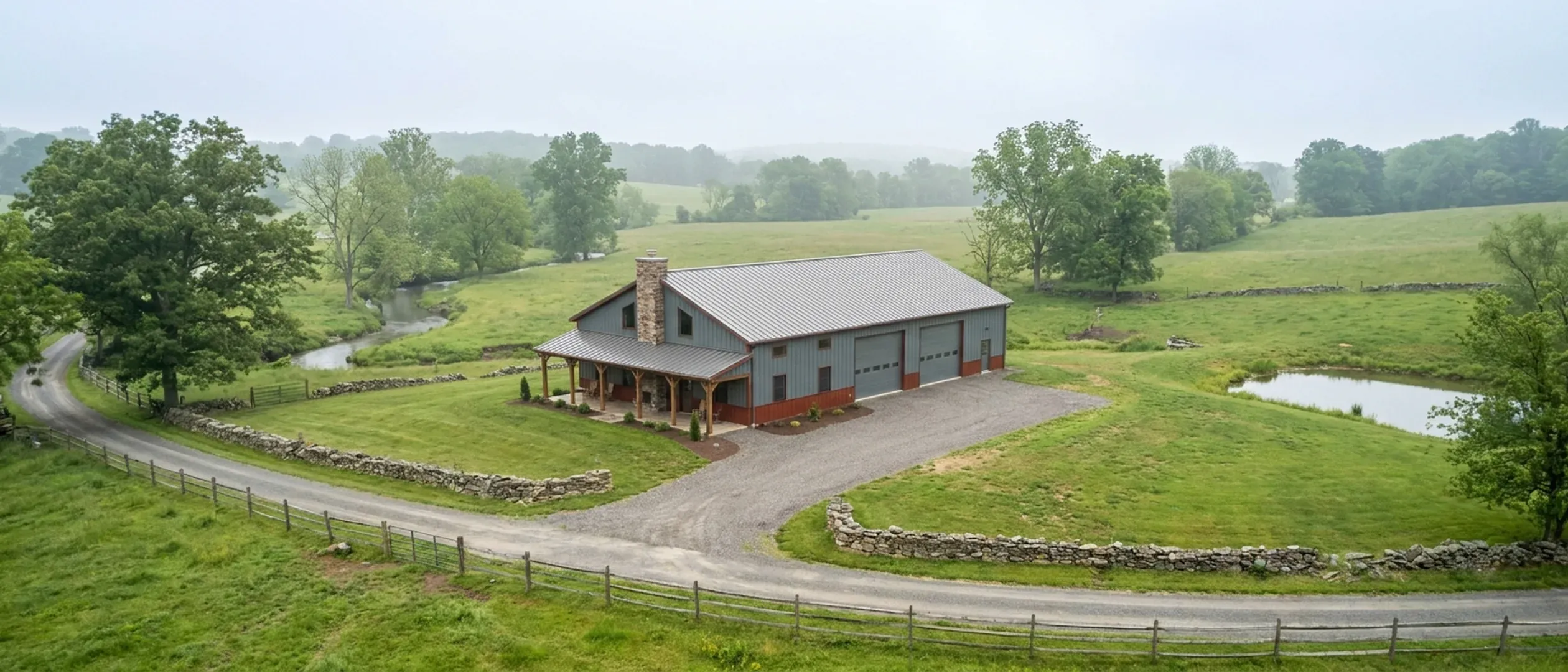
Barndominium Financing in New Jersey: Construction Loans and Limits
A barndominium in New Jersey is normally built on land the owner already has or is buying, under a contract with a builder. That shape decides the financing. A lender is being asked to fund a house that does not exist yet, on a parcel it has to value, in a building type with few local sales to compare against. The loans that fit are construction loans that convert into an ordinary mortgage when the house is finished. This guide covers how those loans are structured, the 2026 loan limits that apply in each New Jersey county, the lenders that specialise in rural property, the State's down payment programme, and the dated rate figures, each with its source. We are not a lender and nothing here is a rate quote.
Figures on this page are cited third-party or government data, not a quote from New Jersey Barndominium Builders.
Bottom Line Up Front
- The usual structure is a single-closing construction-to-permanent loan. Fannie Mae's Selling Guide lets the construction period run no more than 12 months at a time and 18 months in total before the loan converts to a mortgage of up to 30 years.
- FHFA's 2026 conforming loan limit for a one-unit home is $1,209,750 in 12 New Jersey counties and $832,750 in the other 9, so the county where you build changes what a conventional loan can reach.
- Freddie Mac's survey put the average 30-year fixed rate at 7.03% for the week of 24 Sep 2026, against 6.30% a year earlier (week of 25 Sep 2025). Rates move weekly; ask for a current quote.
How a construction-to-permanent loan works
A barndominium is financed the way any custom home is: first as a construction loan that pays the builder in stages, then as a mortgage.
One closing or two
A single-closing loan sets the construction loan and the permanent mortgage in one transaction. A two-closing loan finances construction first and then refinances into a mortgage at completion, with a second set of closing costs and a new rate at that time.
The construction period has a limit
Fannie Mae's Selling Guide (B5-3.1-02) says a single-closing construction-to-permanent loan may have no single construction period over 12 months and no more than 18 months in total, and Fannie Mae will not buy the loan until construction is complete and it has converted to permanent financing. After conversion the term may not exceed 30 years.
The builder is paid in draws
During construction the lender releases money in stages as work is inspected, and you usually pay interest only on what has been drawn. Ask each lender for its draw schedule before you sign a building contract, so the two line up.
Your land counts
Land you already own is usually treated as part of your equity in the finished property. If you are buying land and building, some lenders will finance both; others want the land bought first.
Why the appraisal decides the loan
The lender lends against the appraised value of the finished house, not against the building contract. For a barndominium in New Jersey that is the step to plan for.
Few local comparables
Appraisers value a house against comparable sales nearby. The Census Bureau reports that 97% of contractor-built houses completed in the Northeast in 2025 were wood-framed, with steel under half a percent, so finished barndominium sales to compare against are scarce.
Describe it as a house
Give the lender and the appraiser full plans, the finish schedule and the square footage of living space separately from the shop. A barndominium appraised as a house with an attached garage is easier to value than one described as a metal building.
Shop space is valued differently
A large shop or garage bay adds value, but not at the rate of finished living space. If the plan is mostly shop, expect the appraisal to reflect that.
Plan the gap
If the appraisal comes in under the cost to build, the difference is cash you bring. Know that number before construction starts, not after.
How owners in the Northeast actually pay
The Census Bureau reports how contractor-built houses are financed, and the Northeast pattern is worth knowing before you shop for a loan.
Mostly conventional loans
Of the contractor-built houses started in the Northeast in 2025, the Census Bureau reports 74% were financed with conventional loans and 26% paid for in cash, with FHA and VA loans rounding to zero.
Cash is common
About a quarter of those owners paid cash, according to the same Census table. Some sell a previous home first; some build in phases as money allows.
Government-backed loans are rarer for custom builds
NJHMFA's first mortgages are government-insured (FHA, VA or USDA) loans for buying a home. For a custom build on your own land, ask each lender directly whether it offers a government-backed construction-to-permanent loan.
Rates are dated
Freddie Mac's Primary Mortgage Market Survey put the 30-year fixed average at 7.03% and the 15-year at 6.42% for the week of 24 Sep 2026. Construction loans are usually priced differently from those averages, so treat them only as a reference point.
Reading this because you are weighing a build? The next step is a plan drawn for your program.
What's different about New Jersey
Two conforming loan limits, by county
FHFA's 2026 one-unit conforming loan limit is $1,209,750 in Bergen, Essex, Hudson, Hunterdon, Middlesex, Monmouth, Morris, Ocean, Passaic, Somerset, Sussex and Union Counties, and $832,750 in Atlantic, Burlington, Camden, Cape May, Cumberland, Gloucester, Mercer, Salem and Warren Counties. A loan above the limit for its county is a jumbo loan with its own terms.
NJHMFA down payment help, for purchases
The New Jersey Housing and Mortgage Finance Agency's Down Payment Assistance Program provides up to $15,000, based on the county, to qualified first-time homebuyers purchasing a home in New Jersey, as an interest-free second loan forgiven after five years, paired with an NJHMFA first mortgage. NJHMFA's First Generation programme adds $7,000, for a total of $17,000 to $22,000. Ask a participating lender whether a new build qualifies before you count on it.
Farm Credit lends on rural homes here
The Farm Credit Council lists Farm Credit East among the Farm Credit institutions serving New Jersey. Farm Credit East's rural home lending covers country homes, homes with acreage and farm buildings, rural home lots and new home construction, with long-term fixed rates and, it says, local service for the life of the loan.
Flood zone, flood insurance
Rutgers' New Jersey Climate Change Resource Center notes that federally regulated lenders must require flood insurance on loans secured by property in a FEMA Special Flood Hazard Area. On a Shore or riverside parcel, the premium is part of what the lender underwrites.
The property tax is in the payment
Lenders qualify you on principal, interest, taxes and insurance together. The Department of Community Affairs puts the 2025 average New Jersey residential property tax bill at $10,570, so the tax line in a New Jersey mortgage payment is large, and it varies by town.
Can you get a mortgage for a barndominium in New Jersey?
What is the conforming loan limit in New Jersey in 2026?
How long can a construction loan last?
Does NJHMFA help with a barndominium?
Are there lenders that specialise in rural homes in New Jersey?
What are mortgage rates right now?
Do I need flood insurance for the loan?
Questions answered? Tell us what you want to build and we will put real numbers against it.
Sources
- Fannie Mae Selling Guide — B5-3.1-02, Conversion of Construction-to-Permanent Financing: Single-Closing Transactions — 12-month single period, 18 months total, 30-year term after conversion. Read 26 Sep 2026.
- FHFA — Conforming Loan Limits for Mortgages Acquired in Calendar Year 2026, full county list — New Jersey one-unit limits: $1,209,750 (12 counties) and $832,750 (9 counties). Read 26 Sep 2026.
- New Jersey Housing and Mortgage Finance Agency — Loan Products Fact Sheets and Materials — Down Payment Assistance up to $15,000 by county; First Generation $7,000; five-year forgivable. Read 26 Sep 2026.
- Farm Credit East — Rural Home Loans — Country homes, acreage, rural lots, new home construction; long-term fixed rates. Read 26 Sep 2026.
- Farm Credit — New Jersey — Farm Credit institutions serving New Jersey. Read 26 Sep 2026.
- Freddie Mac — Primary Mortgage Market Survey (history file) — 30-year fixed 7.03% and 15-year 6.42% (week of 24 Sep 2026); 30-year 6.30% (week of 25 Sep 2025). Read 26 Sep 2026.
- U.S. Census Bureau — Number of Contractor-Built Houses Started by Type of Financing — Northeast 2025: conventional 74%, cash 26%. Read 26 Sep 2026.
- U.S. Census Bureau — Type of Framing in New Single-Family Houses Completed — Contractor-built, Northeast 2025: wood 97%, steel under 0.5%. Read 26 Sep 2026.
- Rutgers, New Jersey Climate Change Resource Center — The National Flood Insurance Program and New Jersey — Mandatory purchase for federally backed loans in the Special Flood Hazard Area. Read 26 Sep 2026.
- New Jersey Department of Community Affairs — 2025 Property Tax Information (County Tax Summary) — Average residential property tax bill $10,570, 2025. Read 26 Sep 2026.
Keep reading
The pages that answer the next question this one raises.
How much a barndominium costs in New Jersey
The published cost figures a lender will compare your budget against.
Read itHow big a barndominium your budget builds
Working from a loan amount back to square footage.
Read itBarndominium build timeline
How long each stage takes, and why it matters for a construction loan's time limit.
Read itTurnkey builds
One contract for the whole house, the structure lenders find easiest to finance.
Read itWant a real number instead of a range?
Start the survey and tell us about your land and what you want to build. Include the municipality and the block and lot if you have them, because in New Jersey the town, the land-use rules that cover the parcel and the well and septic answers change the budget more than the building does. The survey costs nothing.